- Medical Sciences Mandi Parishad Rd, Vibhuti Khand, Gomti Nagar, Lucknow,
 Featured
 Dr.Amit Panday
Cancer is not a single disease — it is a broad term that encompasses hundreds of distinct conditions, each originating in different tissues, behaving differently in the body, and responding to different treatments. What works for breast cancer may not work for lung cancer, and what cures an early-stage tumor may be ineffective against a metastatic one. This complexity is precisely why cancer treatment planning is such a specialized and deeply individualized process.
The good news is that India has made remarkable strides in cancer care over the last two decades. World-class treatment options that were once only available abroad are now accessible at leading oncology centers across the country — in major metropolitan cities as well as rapidly growing tier-2 locations. From advanced robotic surgery to precision-based targeted therapies, Indian patients today have access to a wide and highly effective range of treatment options.
This guide explains the three core cancer treatment modalities — surgery, chemotherapy, and targeted therapy — in clear and accessible language. The goal is to help patients and families walk into their oncologist’s office better informed, better prepared, and more confident in participating in important treatment decisions.
Before any treatment begins, an oncologist must first understand the cancer in detail. This process involves several critical diagnostic steps, including a biopsy to confirm the cancer type, imaging studies such as CT scans, MRI, or PET-CT scans to determine how far the cancer has spread, and blood tests or molecular profiling to understand the cancer’s genetic behavior and aggressiveness.
Based on these findings, the oncologist stages the cancer — typically from Stage I (localized and early-stage disease) to Stage IV (advanced cancer that has spread to distant organs). The stage of the cancer, combined with the patient’s overall health, age, lifestyle, and personal preferences, forms the foundation of a personalized treatment strategy.
It is also important to understand that cancer treatment is rarely limited to a single intervention. Most patients receive a combination of therapies — such as surgery followed by chemotherapy, radiation therapy alongside targeted therapy, or immunotherapy added to a standard treatment regimen. This is why leading cancer centers follow a multidisciplinary tumor board approach, where surgical oncologists, medical oncologists, radiation oncologists, radiologists, and pathologists collectively review each case to recommend the most effective treatment plan. Patients treated through such collaborative care models often experience significantly better outcomes than those managed by a single specialist alone.
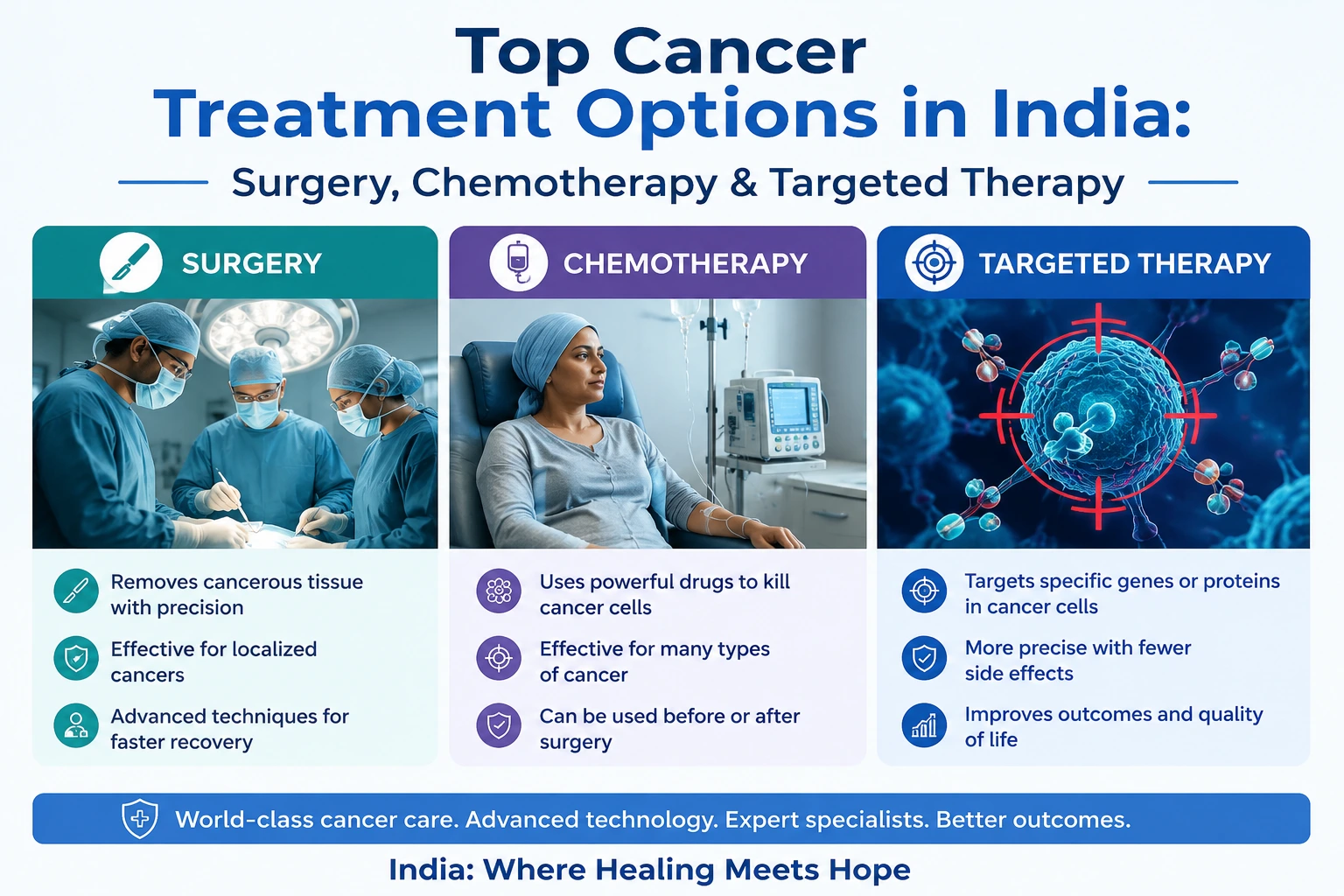
Surgery is often the first and most direct treatment for solid tumors. The primary goal is to physically remove the cancerous tissue from the body — either to cure the disease, reduce the tumor burden, or relieve symptoms that affect the patient’s quality of life. Surgical treatment remains one of the most effective approaches for early-stage and localized cancers where the tumor has not spread beyond its original site.
Curative surgery aims to remove the entire tumor along with a margin of surrounding healthy tissue to ensure that no cancer cells remain. This approach is commonly used in early-stage cancers such as breast cancer, colon cancer, thyroid cancer, and prostate cancer.
Preventive or prophylactic surgery is performed in individuals who are at high risk of developing cancer in the future. Examples include the removal of pre-cancerous polyps or preventive mastectomy in women carrying BRCA gene mutations associated with a significantly increased risk of breast cancer.
Palliative surgery is not intended to cure the disease but rather to relieve pain, reduce obstruction, control bleeding, or improve overall quality of life in patients with advanced-stage cancers.
Minimally invasive and robotic surgery represent some of the most advanced developments in surgical oncology. By using small incisions, high-definition cameras, and robotic-assisted instruments controlled by surgeons, these techniques offer the same effectiveness as traditional open surgery while reducing blood loss, minimizing post-operative pain, shortening hospital stays, and enabling faster recovery.
Surgery is generally recommended when the tumor is confined to a specific area, has not extensively invaded surrounding critical structures, and the patient is physically fit enough to undergo the procedure. It is particularly effective in cases detected at an early stage and is often followed by chemotherapy, radiation therapy, or targeted therapy to eliminate any remaining cancer cells and reduce the risk of recurrence.
Today, advanced surgical oncology services are available across many cities in India — from major metropolitan centers such as Mumbai and Delhi to rapidly developing oncology hubs in states like Uttar Pradesh, Punjab, and Karnataka. This growing accessibility is helping more patients receive timely and specialized cancer care closer to home.
Chemotherapy is the use of powerful anti-cancer drugs to destroy cancer cells throughout the body. Unlike surgery, which focuses on a specific tumor location, chemotherapy works systemically by traveling through the bloodstream to reach cancer cells wherever they may exist. This makes it especially effective for cancers that have spread or have a high risk of spreading to other parts of the body.
Cancer cells grow and divide rapidly in an uncontrolled manner. Chemotherapy drugs target this rapid cell division by damaging the DNA of cancer cells or interfering with the processes that allow them to replicate and survive. Because these medications circulate throughout the body, they can attack microscopic cancer cells that may not be visible on scans or accessible through surgery.
Adjuvant chemotherapy is administered after surgery to eliminate any remaining cancer cells and reduce the risk of recurrence. Neoadjuvant chemotherapy is given before surgery to shrink tumors and improve the chances of successful surgical removal. Palliative chemotherapy is used in advanced-stage cancers to slow disease progression, reduce symptoms, and improve the patient’s quality of life, even when complete cure may not be possible.
Chemotherapy can cause side effects such as hair loss, nausea, fatigue, weakness, and an increased risk of infections because the drugs may also affect healthy cells that divide rapidly, including those in the hair follicles, digestive tract, and bone marrow. However, chemotherapy care has improved significantly in recent years. Modern supportive medications effectively control nausea and vomiting, growth factor injections help maintain healthy blood cell counts, and newer drug delivery techniques minimize damage to healthy tissues. As a result, many patients today tolerate chemotherapy far better than in the past.
Chemotherapy remains a cornerstone treatment for blood cancers such as leukemia and lymphoma, advanced solid tumors, cancers that have spread to multiple organs, and situations where surgery alone cannot completely remove all cancer cells. It is often combined with surgery, radiation therapy, targeted therapy, or immunotherapy as part of a comprehensive cancer treatment plan.
Targeted therapy represents one of the most important advances in modern oncology. Unlike chemotherapy, which attacks all rapidly dividing cells, targeted therapy uses drugs specifically designed to interfere with particular molecular targets — usually proteins, receptors, or genetic mutations — that are present in cancer cells but not in most healthy cells.
This precision-based approach allows treatment to attack cancer with far greater accuracy while minimizing damage to surrounding healthy tissue. As a result, many patients experience fewer side effects and a better quality of life during treatment compared to traditional chemotherapy.
The key difference between chemotherapy and targeted therapy lies in specificity. Chemotherapy acts as a broad systemic attack against rapidly dividing cells, whereas targeted therapy functions more like a precise molecular strike aimed at the specific abnormalities driving cancer growth.
Before recommending targeted therapy, oncologists typically perform molecular profiling or genetic testing of the tumor to identify actionable mutations or biomarkers. Targeted therapy is considered only when a targetable mutation or protein is detected within the cancer cells.
Monoclonal antibodies are laboratory-engineered proteins that attach to specific targets on cancer cells. They may block growth signals, prevent blood supply formation, or help the immune system recognize and destroy cancer cells more effectively.
Small molecule inhibitors are drugs capable of entering cancer cells and blocking the internal signaling pathways responsible for cell growth, division, and survival. These therapies are commonly used in cancers with well-defined genetic mutations.
Targeted therapy offers several important benefits, including fewer side effects than conventional chemotherapy, improved quality of life during treatment, and highly effective outcomes in cancers driven by specific mutations. Examples include HER2-positive breast cancer, EGFR-mutant lung cancer, and chronic myeloid leukemia (CML).
Today, targeted therapy is increasingly available at advanced oncology centers across India. Patients often seek consultation with experienced cancer specialists to identify the most appropriate personalized treatment strategy for their cancer profile. Specialists such as Dr. Lovedeep Singh, a practicing surgical oncologist in Punjab, are known for offering evidence-based and modern cancer treatment approaches, including precision-targeted therapies tailored to individual patient needs. Other experienced oncologists, including Dr. Amit Pandey in Lucknow and Dr. Yuvraj Singh in Kanpur, have also contributed significantly to expanding access to advanced targeted therapy treatments in India.
Despite its advantages, targeted therapy also has limitations. It only works when the specific molecular target is present within the cancer. In some cases, cancers may eventually develop resistance to the treatment over time, allowing the disease to continue growing despite ongoing therapy.
Beyond surgery, chemotherapy, and targeted therapy, Indian oncology centers now offer several other sophisticated treatment options. Immunotherapy harnesses the patient's own immune system to recognize and attack cancer cells — a breakthrough that has transformed outcomes in melanoma, lung cancer, and several other cancers. Radiation therapy, using high-energy beams to destroy cancer cells, is used both as a primary treatment and alongside surgery or chemotherapy. Hormone therapy is effective for cancers that are driven by hormones, particularly breast cancer and prostate cancer, by blocking the body's ability to produce those hormones or preventing cancer cells from using them.
The right treatment is never a generic recommendation — it is the product of detailed analysis and expert judgment applied to your specific situation. Key factors include the type and stage of your cancer, your age and overall physical health, whether the cancer has specific targetable mutations, the availability of the required treatment locally, and the financial feasibility of the recommended regimen.
Personalized treatment planning — not a one-size-fits-all protocol — is what separates good oncology care from great oncology care. Always ensure your treating oncologist is recommending a plan built around your cancer's specific biology and your personal circumstances.
Access to advanced cancer care has expanded considerably in India in recent years. While Mumbai, Delhi, Chennai, and Hyderabad continue to be major cancer care hubs, states like Uttar Pradesh, Punjab, Rajasthan, and Karnataka have seen rapid growth in specialized oncology infrastructure. Many patients today explore treatment options beyond their home city to access experienced specialists across regions — a trend that reflects both the increasing mobility of patients and the improving quality of regional cancer centers.
Cancer treatment costs vary widely depending on the modality, duration, and institution. Surgical procedures can range from affordable at government hospitals to significantly higher at private centers. Chemotherapy costs depend on the drugs used and the number of cycles required. Targeted therapy, being more specialized, tends to be more expensive — though many pharmaceutical companies now offer patient assistance programs to improve accessibility. Discussing costs openly with your oncologist and hospital's financial counselor at the outset helps families plan without unwelcome surprises.
Do not delay seeking treatment once a diagnosis is confirmed — early intervention consistently leads to better outcomes. Take a second opinion, especially for complex or rare cancers. Maintain a strong emotional support system around the patient; mental health is an integral part of cancer recovery. Follow your doctor's treatment schedule strictly, attend all follow-up appointments, and communicate any side effects promptly rather than suffering in silence.
India today offers a full spectrum of cancer treatments — from time-tested surgical techniques to the most advanced precision therapies available globally. Surgery, chemotherapy, and targeted therapy each have a defined role, and the best outcomes come from combining them intelligently under the guidance of an experienced, specialized oncologist.
The key takeaway is simple: the right treatment choice depends on expert guidance, not guesswork. Whether you seek care in your own city or consult a specialist in another state, prioritize expertise, infrastructure, and a doctor who treats your cancer as the specific, individual disease that it is. Make the decision early, make it informed, and move forward with the confidence that the right help is available.
